Businesses are no longer questioning whether artificial intelligence works. The focus has shifted to where exactly it delivers measurable impact — in speed, quality, and cost of operations.
In most companies, losses are happening every single day:
engineers spend hours on analysis instead of resolving incidents
customers can’t find what they’re looking for and abandon the platform
contact centers can’t scale because of human resource constraints
These aren’t isolated issues — they represent systemic inefficiency in operations. For each of these scenarios, our team of AI architects designs purpose-built solutions: with clear architecture, thoughtful integration, and defined performance metrics.
Below are four practical cases with concrete outcomes.

Industry: retail
Focus area: DevOps / infrastructure management
Technology: LLM via cloud platform
Context
A major Ukrainian retailer running a hybrid infrastructure faced a common but expensive problem: during outages, engineering teams were spending hours hunting for the root cause instead of fixing it.
In a distributed infrastructure, the challenge isn’t the incidents themselves. It’s how quickly you can understand what went wrong.
The Problem
hundreds of alerts per day with no prioritization
siloed tools with no unified context
manual analysis of thousands of log lines
The Solution
An AI assistant was deployed directly into the monitoring stack. Engineers no longer waste time on manual searches — the system performs real-time diagnostics.
How It Works
log analysis across all system components
cross-service anomaly correlation
plain-language diagnostic summaries
remediation recommendations
automatic ticket creation in alerting systems
mean time to resolution (MTTR) reduced by 10x
–70% time spent on manual log analysis
fewer and shorter unplanned outages
reduced operational losses
reallocation of engineering capacity
improved infrastructure predictability
Industry: omnichannel retail
Focus area: customer experience
Technology: LLM via AWS
Context
Customers don’t want to spend time searching through a website. A large catalog without intuitive navigation is a direct cause of lost sales. The support team carried an additional burden: questions about orders, returns, and product specs repeated themselves every day.
The Problem
friction-heavy search → high bounce rate
low conversion in sessions without a sales consultant
support overloaded with simple, repetitive requests
The Solution
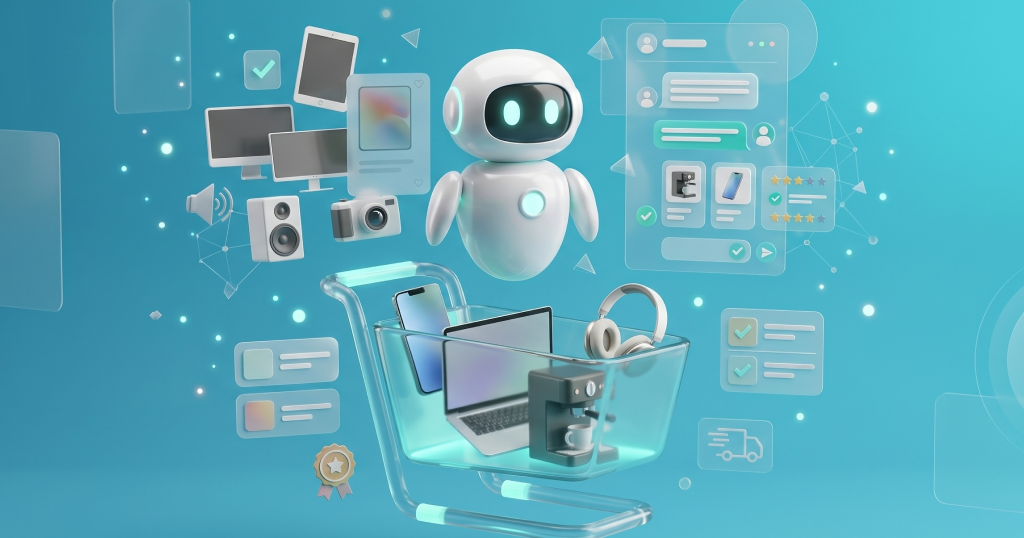
Taking inspiration from Amazon Rufus, we built a unified shopping assistant across all channels: website, mobile app, and in-store kiosks. One tool instead of a fragmented experience.
How It Works
personalized recommendations through natural language interaction
real-time catalog search with filters for price, size, availability, and compatibility
product comparisons, feature explanations, cross-sell and upsell
first-line support automation: handling routine queries and routing complex cases
conversion in AI-assisted sessions increased by 8–12%; most pronounced in high-consideration categories: appliances, TVs, smartphones, laptops
NPS improved by 5–8 points; share of positive service ratings up approximately 10%
more requests resolved successfully without growing the team
Satisfaction metrics were measured among users who actively engaged with the assistant — an already-interested audience with a clear intent who experienced direct value.
Customers don’t leave because the product isn’t there — they leave because they can’t find it quickly enough. The assistant closes that gap: it shortens decision time, reduces drop-off caused by choice overload, and accelerates the path to purchase. At the same time, it replaces a live consultant in the online channel, offloading support and reducing traffic to physical stores.

Industry: insurance / financial services
Focus area: quality control and compliance
Technology: LLM via cloud platform
Context
A national insurance company was consistently dealing with poor-quality applications at intake: incomplete data, document errors, procedural violations. Every such case triggered an expensive cycle of manual review and rework.
The Problem
clients submitted applications with errors or missing documents
staff collected data incorrectly at the intake stage
errors were caught late — only after passing through several processing stages
The Solution
An AI assistant validates applications at the point of entry.
How It Works
automatic validation of each application against business rules
detection of missing fields, inconsistencies, and procedural errors
structured reports with specific, actionable comments
separate feedback loops for clients and staff
automatic audit trail generation for compliance purposes
less rework
faster review cycles
higher data quality
Quality is built in at the front door — before an error has a chance to travel further. The assistant monitors both sides of the process and maintains a complete audit trail.

Industry: telecom
Geography: Georgia
Focus area: customer service
Technology: LLM
Context
A unique situation: a major telecom operator in Georgia faced a rare combination of challenges occurring simultaneously — linguistic diversity, multiple writing systems, and a fragmented knowledge base.
The Problem
Multilingualism as a bottleneck.
What made every agent’s workday harder:
customers communicated in three languages (Georgian, Russian, and English) using three different scripts
the internal knowledge base was spread across four languages: KA, RU, EN, NL
during live interactions, agents couldn’t quickly locate relevant information — the language of the query and the language of the documentation rarely matched
The outcome: slow response times, inconsistent answers, and chronic team overload.
The Solution
We deployed a multilingual AI assistant integrated directly into the contact center’s workflows. The assistant acts as a real-time Copilot for agents — instantly surfacing relevant information from the knowledge base regardless of the query language or documentation language.
How It Works
recognition of three languages and scripts: Georgian (Mkhedruli), Russian (Cyrillic), and English (Latin)
cross-lingual knowledge base search across four languages (KA, RU, EN, NL)
real-time response suggestions for agents during calls and chats
automatic language detection and text normalization
a unified knowledge interface replacing fragmented multilingual documentation
response time: from ~10 minutes down to 1–2 minutes
more requests handled without expanding the team
4-language coverage at no additional cost
AI removes the language barrier as a source of inefficiency — the situation where a customer waits while an agent searches through foreign-language documentation — and makes it possible to scale support without growing headcount.
Find out where your processes are already losing time and money — book a free session with an AI architect
If your team spends time every day manually gathering and reconciling data, handling the same types of requests over and over, or waiting for information to pass through multiple layers — the optimization potential is already there. What’s left is identifying it properly.
Submit a consultation request and, based on your specific processes, we’ll identify:
exactly where time and resources are being lost
which scenario will deliver the greatest impact
how it can be implemented